Home / About / Commercial Producer of the Year

Commercial Producer of the Year

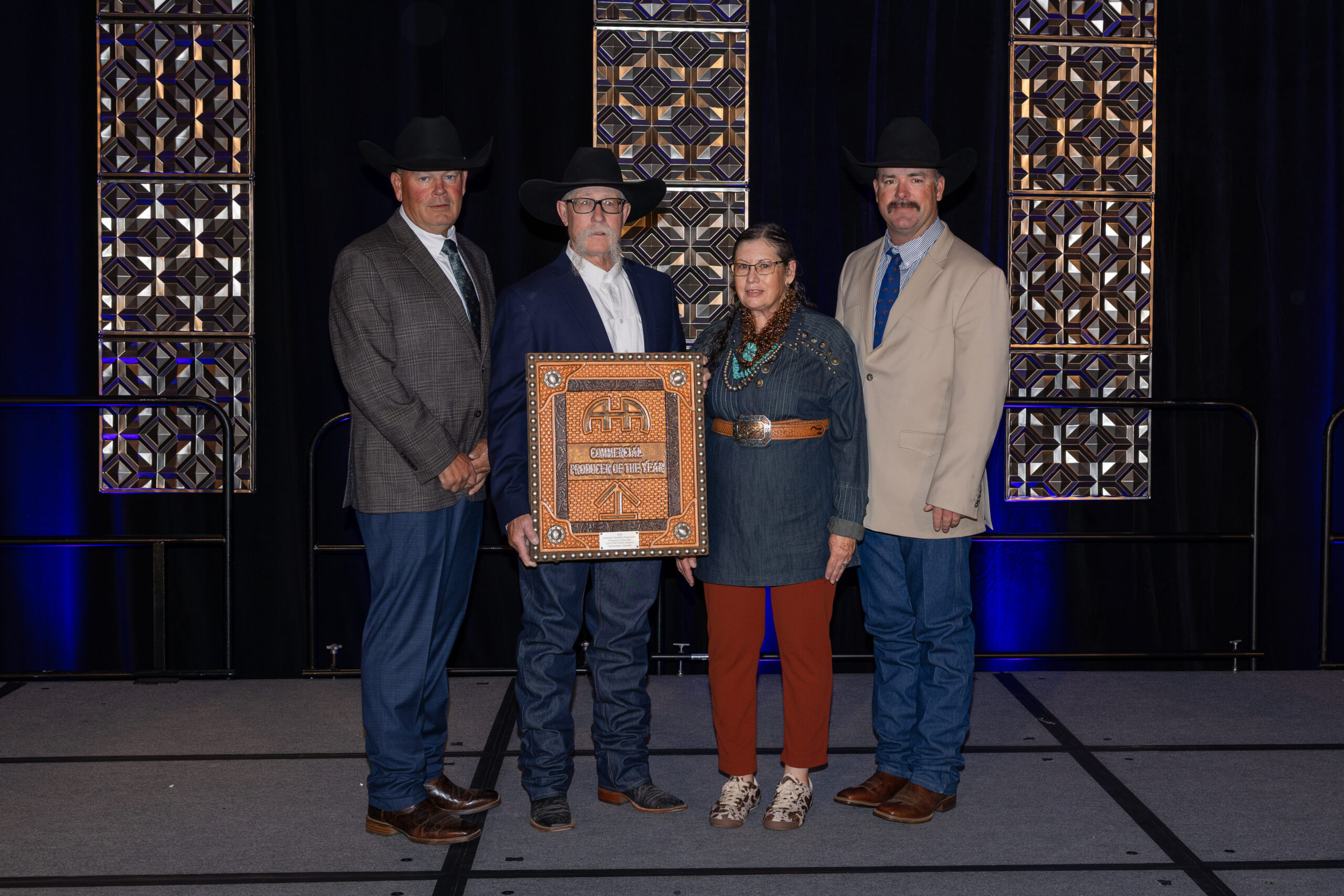
Annually, the American Hereford Association presents the Commercial Producer of the Year award to an operation that serves as a stellar example of how progressive commercial cattlemen can increase profitability through Hereford’s added heterosis. Hereford genetics play a vital role in the commercial industry, and the American Hereford Association is honored to recognize those who have taken advantage of heterosis each year at the Annual Meeting in Kansas City, Mo. Nominations are due March 1, 2027.

A herd of black and white cattle standing in a grassy field with rolling green hills and trees in the background.

Crystal River Ranch, Carbondale, Colo.

The Crystal River Ranch runs 500 head of commercial cows along Colorado’s Western Slope in the Roaring Fork Valley and the Cottonwood Pass area southeast of Glenwood Springs, near Carbondale, Colo. The ranch raises Hereford-Angus cross cattle at 6,500-10,000 feet elevation. Crystal River’s cattle thrive even in the harsh, high-mountain winters stretching from October until late April, when the deep snow finally starts to melt. 

Crystal River Ranch started with straight Hereford cattle, adding calving-ease Angus genetics to their herd over the last 30 years. Currently the cow herd is split evenly between Hereford and Angus cows, as is the bull battery. 

PNS_1376-2-1-scaled.jpg

The operation raises its own replacements and artificially inseminates (AIs) their home-bred heifers to calving-ease Angus bulls with added carcass and growth merit. Each year in mid-June, 300 of Crystal River’s mature cows are also AIed to both Hereford and Angus sires to optimize heterosis and hybrid vigor. All sires are expected to be curve-benders — calving ease sires with low birth weights yet heavy weaning weights — in addition to having good scrotal circumference, moderate milk and excellent carcass expected progeny differences (EPDs). Replacement female selection focuses on functional traits, such as muscle, volume and correct structure, while choosing heifers that are early-born and average weight. 

Owner Sue Anschutz-Rodgers has been at the helm since 1987, and her family has owned the operation since 1958. Each day, she and her team focus on ensuring every cow weans a healthy, marketable calf to either sell at a premium price or to develop to become a productive cow. They utilize the assets of the ranch; cattle, land, water, grass and labor as efficiently as possible to accomplish this goal.

Crystal River Ranch markets their spring-born commercial feeder calves each fall through Superior Livestock Video, private treaty sales and the local sale barn. Anschutz-Rodgers notes how rewarding it is when buyers don’t sort single animals off after weighing the group — a common occurrence at Crystal River. She and her team also have sold heifer calves by grouping them as sets of Hereford or black baldy replacements to sell at a premium above the market. With targeted crossbreeding, AI and quality genetics, Crystal River Ranch’s weaning weights have improved from 480 to 625 pounds since 2009.

Anschutz-Rodgers is also dedicated to the industry as a whole. She serves on the board of directors for the National Western Stock Show (NWSS) and was a founder of the Colorado Cattlemen’s Agriculture Land Trust. Anschutz-Rodgers was the first woman to receive the coveted NWSS Citizen of the West award in 2006. Crystal River Ranch was named the Colorado Cattlemen’s Commercial Producer of the Year in 2018. Tom Harrington, longtime ranch manager, served as the president of Colorado Cattlemen’s Association in 2024-25 and continues to serve on the board. 

SS25-WHC-01247-scaled.jpg

Groendyke Ranch, Nash, Okla.

Groendyke Ranch, located in Nash, Okla., is ran day-to-day by ranch manager, Paul Koffskey. The ranch uses top quality, genomic-tested, multi-trait-selected, curve-bending sires from progressive Hereford breeders to cover more than 70% of the operation’s 1,500 Angus and Red Angus cows. With eight years of data collected across the cow herd, ranging from weaning weight to calving intervals, Koffskey chisels away at the Groendyke commercial cow herd’s inputs while optimizing outputs.

Ranch manager, Paul Koffskey, tracks the additive effect of bald-faced hybrid vigor with the operation’s extensive record-keeping system powered by GEM herd management software. With eight years of data collected across the cow herd, ranging from weaning weight to calving intervals, Koffskey chisels away at the Groendyke commercial cow herd’s inputs while optimizing outputs. His numbers prove the Hereford influence not only pencils but pays.  Using genomic-tested sires allows Koffskey to confidently make mating decisions, and the added accuracy of buying Hereford herd sires with genomic-enhanced expected progeny differences (GE-EPDs) helps the ranch make more rapid genetic progress. Groendyke Ranch carefully evaluates its bull battery’s performance with the data they collect, including recording individual weaning weights. 

The operation applies the same scrutiny and high standard to its cow herd. The cows graze native grasses in north central Oklahoma, and they’re expected to wean calves half their body weight by 205 days actual age and breed back with no added inputs outside of harsh winter weather. The operation’s record-keeping system separates the low-performers and females that fall outside of their calving window; these cows are culled on their first strike with no questions asked. Groendyke Ranch’s Hereford-influence steer calves are enrolled in the Hereford Advantage program provided by the American Hereford Association (AHA) and IMI Global. These age- and source-verified calves must adhere to specified vaccination protocols and be sired by Hereford bull batteries ranking in the top half of the breed for AHA’s Certified Hereford Beef® Index.

For the past three years, Groendyke calves enrolled in the program brought top dollar in the Cherokee Sales Co. Hereford-influenced Special in Cherokee, Okla. A recent consignment of 400 Hereford-sired calves brought $11-13 per hundredweight more than any lot at the sale. A few years ago, Groendyke Ranch established a bred commercial female sale to further capitalize on the genetic selection and evaluation behind their operation. The commercial heifer sale started as a way to diversify the operation’s income beyond the feeder calf market. Koffskey saw there was a need for quality replacements, and each year, the sale grows alongside the demand for the Hereford-sired replacements they offer. 

Recently, Groendyke Ranch calved out the operation’s first set of baldy females after retaining some of the Hereford-sired heifers they raised. As first-calf heifers, the group weaned calves weighing 575 pounds at 205 days of age with a 92% breed-back in a 60-day breeding season. Koffskey and his crew are excited about the addition of these F1 females. Repeat buyers of the ranch’s commercial females shows other commercial cattlemen feel the same way. Whether marketing feeder calves, replacement females or calving out Hereford-sired heifers, Groendyke Ranch’s data clearly shows the bald-faced advantage of Hereford influence.

Ellsbury Ranch, Sundance, Wyo.

Ellsbury Ranch LLC is a fifth-generation cow-calf and yearling operation in northeastern Wyoming, owned and operated by Colter and Sarah Ellsbury, and Jeff and Whitney Stull. The couples purchased the cattle and equipment in 2017 and enjoy raising their families on the ranch and teaching their children about the ins-and-outs of the operation. Together the Ellsbury and Stull families are raising six kids from ages of 2 to 14 alongside the cattle operation — Lyman, Ridley and Mattie Ellsbury, and Ruby, Sutton and Weston Stull.

Six people in western attire pose together on stage holding a large engraved award plaque against a black backdrop.

Ellsbury Ranch roots reach back to 1885, when their great-great-grandfather moved his family West from Minnesota to land in Beulah, Wyo., where they successfully set up a general store, feed stable and hotel. The family pulled up stakes in Beulah in 1891 and settled along the creek in Farrall, Wyo., the modern-day headquarters of the ranch.

Initially, Ellsbury Ranch was home to Hereford cattle, but in the ’90s the herd transitioned to black baldies before becoming home to solely black-hided cattle in the 2000s. But, after Ellsbury and Stull acquired the herd, they felt like they needed a change to bolster performance, despite their strong commercial Angus cow herd. So, Ellsbury Ranch welcomed back Hereford sires in 2018, when they purchased three bulls from Frederickson Ranch, Spearfish, S.D. The resulting black baldy calves showed the textbook example of heterosis firsthand, with the bald-faced calves consistently weaning at heavier weights than their black-hided peers. With this added boost in pounds and performance, Ellsbury Ranch sold its last black bull in 2023 and now has an entirely Hereford bull battery to make black-white-faced, Hereford-sired calves.

Today, Ellsbury Ranch runs 550-head of black-hided cows, a Hereford bull battery and about 300 yearlings on 19,000 acres of privately leased and forest service ground deep in the Black Hills. Their black baldy calves are consistently at the top-of-the-market, whether they are sold through Superior Livestock, the local sale barn or privately, off-the-ranch. Ellsbury Ranch has traditionally sold its steer calves through Superior Livestock and marketed their heifer peers privately or through the local auction barn. But, as demand has increased in their area for black-white-faced, F1 replacements, Ellsbury and Stull have more opportunities to market their heifer calves as replacements. Local ranchers have been demanding Hereford-sired, black baldy replacements because their maternal heterosis coupled with their docility, efficiency and longevity that are second to none. Last year, the operation’s heifer calves were sold after the steers on Superior Livestock’s Bighorn Classic.

With the added pounds, demand and docility the bald faces brought to Ellsbury Ranch, the families have no plans to change their business model. Ellsbury and Stull plan to continue to market all of their in-demand black baldy cattle — selling steers through Superior and finding value-added outlets for their replacement-quality heifer peers. By bringing in black-hided replacements to pair with their Frederickson Ranch Hereford bull battery, Ellsbury Ranch will consistently have a calf crop of entirely black baldy F1s — just the way they like it.

Four people in western attire holding a large engraved award plaque on carpeted stairs with curved railings.

Circle B, Big Horn, Mont.

Circle B is an Eastern Montana commercial cattle operation owned by the Borman family and run by just over a dozen cowboys and their families. The Bormans breed their 1,600 straightbred Angus cows to Hereford bulls to make uniform, high-performing baldy calves that are the epitome of Hereford heterosis.

Circle B was founded by the father-son duo Frank and Fred Borman in 1998. Patriarch Frank Borman is known as an astute businessman not afraid to shoot for the moon — literally. Borman commanded Apollo 8, the first mission to fly around the moon. And when it comes to Circle B, the Borman family is equally as pioneering and progressive. For more than two decades, Circle B has served as a textbook example of a profitable cow-calf operation, mixing management, good ol’ fashioned stockmanship, benchmarking metrics and complementary genetics.

Fred’s wife, Donna, was the one in the family first taken with the latter. She read about the power of crossbreeding in “Storey’s Guide to Raise Beef Cattle” when the family first began their foray into Big Sky Country. Today, Circle B’s F1 cattle reflect the family’s commitment to artfully melding progressive ideas with proven tactics and business savvy with industry tradition. And the operation’s use of Hereford genetics pays off in the bull pen, at feeder calf sales, for their repeat buyers and in their budding replacement female market.

For more than 20 years, Feddes Herefords, Manhattan, Mont., has served as Circle B’s bull supplier. The resulting black baldy calves are uniform, fast-growing, efficient, healthy and manageable, the feeder cattle are also backed by Circle B’s progressive management. Circle B calves are enrolled in the following value-added programs: Non-Hormone Treated Cattle (NHTC), Where Food Comes From CARE Certified, Superior Verified, VAC 60, Superior Progressive Genetics, Beef Quality Assurance (BQA), IMI Global Certified and Hereford Advantage.

While not all buyers offer Circle B carcass data, the figures that do roll into eastern Montana are impressive. Adams Land and Cattle purchased more than 400 steers and reported that the lot gained 4 pounds per day with just over 91% grading USDA Prime and Choice. These bald-faced cattle making the grade further prove the merit of the F1 cross’ profitability from gate to plate.

This year, for the first time, Circle B retained all their F1 black baldy females to market as bred heifers. Their progressive management and the Hereford-influence shine in this set of replacements who spent their summer grazing at the ranch’s Miles City, Mont., location.

Circle B stands as a stellar example of how progressive commercial cattlemen can increase profitability through Hereford’s added heterosis and the baldy advantage.