
Century Breeders
The Century Breeder award recognizes Hereford breeders who have stood the test of time and have been dedicated to raising Herefords for more than 100 years.
The Century Breeder award recognizes Hereford breeders who have stood the test of time and have been dedicated to raising Herefords for more than 100 years.
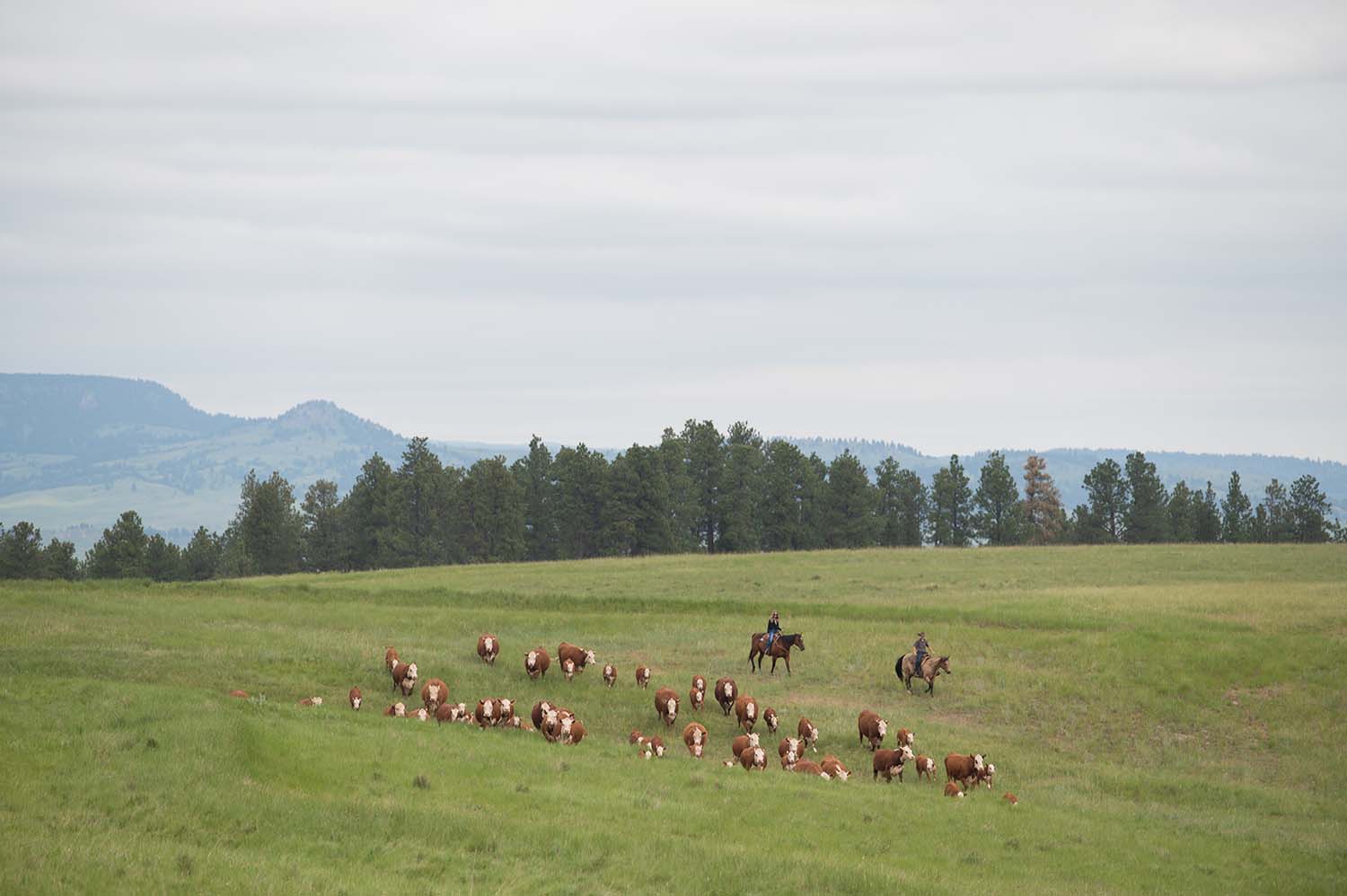
The Johnson family has raised Hereford cattle for 105 years on their farm near Milford, Iowa. E.O. Johnson and his wife, Esther, started the breeding program in 1918. They purchased 10 registered cows and a bull and walked them home 30 miles from Sioux Rapids, Iowa. E.O.’s son, Dale, went into partnership with his dad in 1941. Jack, E.O.’s grandson, showed champion steers at the local county fair in the early ’60s. Jack graduated from veterinary school in 1970, and he and Lynne got married that summer. In 1977, he moved home and went into partnership with his dad, Dale. He and Lynne have four sons, Jim, Chris, Louis and Tom, who grew up taking care of the cows and calves and showing Herefords at the county fairs. The cow herd presently consists of around 50 cows of which 10 are AHA Dams of Distinction (DODs) and many others are daughters or granddaughters of DODs. Today, Jack’s grandkids are now involved in showing the Hereford cattle. Grandson, Wyatt, won the AHA Shootout contest in 2018 with a set of Johnson steers.
Noack Herefords, Rockdale, Texas, was established in 1921 by E.H. Noack, who registered the 7- brand. When E.H.’s only son, Leon, returned home from Texas A&M, his graduation was rewarded when he was named the cow herd manager. After E.H.’s untimely death a few years later, Leon assumed full responsibility for the ranch and made it into the operation it is today. Leon spent countless hours studying pedigrees and collecting performance data. Noack Herefords was an early adopter of the Total Performance Registry Program. The operation focused on creating the ideal mama cow, improving birth weights, milking ability and longevity.
Leon spent time working as a meat grader, which taught him the value of consistently producing delicious, tender meat. He was diagnosed with Alzheimer’s disease in 2000 and lost the battle in 2015.
Today, the family ranch consists of three separate cow herds that cooperate on genetics and marketing. Noack bulls are guaranteed to work for four years.
Noack Herefords firmly believes form follows function, and the most functional cows are also the most profitable. They have been tremendously blessed and hope to operate another 100 years.
The Smathers Hereford Ranch, Llano, Texas, was established in 1886 by James Jefferson Smathers in the heart of the Texas Hill Country in Llano County, Texas. James purchased about 500 acres shortly after he married Harriet Spinks, and he purchased his first Hereford cattle shortly after. Over the past 135 years, the ranch has passed from father to son for five generations.
The Smathers Ranch has evolved from 500 acres of raw pastureland to a highly managed, improved grasses, cultivated fields and rotational cell-grazing operation, which maximizes herd production and capacity.
Initially, Smathers Herefords was a commercial herd marketed through on-farm production sales. However, as times have changed and fifth-generation heir, Slade Smathers, showed interest in raising, exhibiting and marketing his own show cattle, production progressed into an AI/embryo system targeted for registered Hereford cattle and show calf sales.
Today, the Smathers Ranch continues to grow and evolve under Rick’s strong belief and commitment to leave things in good working order for future generations.
The modern day Sidwell Herefords of Carr, Colo., was started in Queen City, Mo., by a young man, G.A. Sidwell in 1908. G.A. imported his first cow, Brampton Agnes VI, from Herefordshire, England. His first bull was Columbus Regent.
In 1911, the bull, Disturber 4th was purchased in the Des Moines, Iowa, Disturber Sales, where many bulls and females were sold. From 1920-1930, G.A. and his sons hosted production sales at the farm in Queen City. In 1930, Sidwell moved his family to the area in Colorado that now serves as home of Sidwell Herefords.
G.A. and his son F.A. hosted their first production sale in 1940, with others to follow in 1945 and 1947. Also in 1947, Sidwell’s purchased half interest in Colorado Baldwin from Jeffers in New Mexico and eventually had full possession of the bull. Annual production sales then began in 1953, with many of those sales being referred to as the Home of Colorado Baldwin Sale.
F.A. Sidwell continued the family tradition and formed a corporation with his three sons Harold, Walter and Richard. Harold continued with the legacy upon the corporation being dissolved in 1971. Harold strived for top end Hereford cattle. He purchased Britisher 33 from Wyoming Hereford Ranch and mated him to Colorado Baldwin daughters, creating the bloodline Cadets, which were featured in the annual bull sales. The final production sale at the Sidwell Herefords Ranch was the fall of 1981. With that being the final sale year, production sales spanned 34 years at the ranch near Carr.
In 1985, Harold and his wife, Marlene, formed a new partnership with their son, Bryan. With this partnership, the name of Sidwell Herefords would now be five generations.
In September 2008, a 100-year celebration was held at the ranch near Carr. Then in September 2009, Bryan married Linda Stangle of Stangle Herefords in Nebraska. To that union, Sidwell Herefords was expanding and changing again.
In 2011, Harold was inducted into the prestigious AHA Hereford Hall of Fame.
Harold and Marlene, along with Bryan and Linda, operated Sidwell Herefords as a partnership until Harold and Marlene retired in 2013. Bryan and Linda, along with daughter Brooke, who served on the NJHA board of directors as vice chairman in her final year on the board, continue to grow and improve Sidwell Herefords.
Cottage Hill Farm was established in 1896 by Clarence and Sarah Taylor (Sonny’s grandparents), who purchased the original 190-acre tract of land resting in the beautiful Potomac Valley in Petersburg, W.Va. Clarence purchased the first registered Hereford cattle in 1920.
Cottage Hill Farm continued in the registered Hereford business through the years. Bulls and heifers were marketed through on-farm production sales starting in 1966 and continued through 1985. Currently they market our registered Hereford cattle by Private Treaty, Beef Expos in West Virginia, Kentucky and Virginia and Producer Consignment Sales in West Virginia, Kentucky, Ohio and Virginia.
The farm currently runs approximately 200 head of registered Hereford cows on 1,000 acres. Cottage Hill Farm is family owned and is operated by W.C. (Sonny) and Carole Taylor, along with their three sons and families. Cottage Hill Farm has been overseen by several generations of the Taylor family and they are as follows:
First generation – Clarence and Sarah Taylor
Second generation – Hogueland and Wayne Taylor
Third generation – W.C. and Carole Taylor
Fourth, fifth and sixth generations – Mark, Michael and William Taylor and their families.
The Taylor family strives to breed and sell the best Hereford genetics possible to not only improve their herd, but to improve your herd and the future of the Hereford breed.
Bayers Hereford Ranch was established in 1918 by Art and Elizabeth Bayers in Lavina, starting the family’s 100-year journey in the registered Hereford business. In the early to mid1930s, the family moved to a ranch near Twin Bridges which came with a beautiful, three-story round barn famous for raising Montana’s only Kentucky Derby winner, Spokane. Years later, the barn became just as famous for raising and selling registered Herefords.
In 1953, Art and Elizabeth’s son, Byron, married Pauline Oberg and they raised three children — Rich, Kathy and Jill — who were all actively involved in the ranch through the 1980s. In 1997, their daughter, Jill, and her husband, Marc, along with Byron and Pauline formed the publication Hereford America.
Byron served on the AHA Board in the 1970s and was elected president in 1976. He attended World Hereford Conferences in Canada and Uruguay and went to Hungary to act as an AHA consultant in selecting Herefords. In 2009, he was the recipient of the Canadian Hereford Ambassador Award, and was inducted into the Hereford Heritage Hall of Fame in 2017 — an honor for the entire family.
During its history, the ranch produced more than 25,000 purebred Herefords, selling cattle to buyers from 38 states within the U.S. as well as to Mexico, Canada, Hungary and Zimbabwe. Bayers sold much of the herd in 1990 but eventually built a herd of about 100 cows. The majority of this second herd was sold a few years ago, but once again, Byron hung onto a few head and rebuilt.
Sadly, Both Byron and Pauline have passed away, but the family continues to carry on the ranch and its traditions. The family still owns a small herd of registered Herefords and small herd of commercial Hereford cows.